Comprehensive Electricity Planning Resource Library
This library of resources, compiled through the NARUC-NASEO Comprehensive Electricity Planning Initiative, includes reports, webinars, policy documents, and webpages that can assist state decision-makers and practitioners working on comprehensive electricity planning policy, modeling, and utility regulation.
The resource library is organized by resource type, planning category, planning scope, key topics, and year to help users quickly locate materials relevant to their interests or work.
These guidance, resources, and examples will assist members in implementing the Comprehensive Electricity Planning in an Era of Load Growth Roadmaps developed through the Initiative. The planning category & planning scopes filters correlate with the Initiative’s Roadmaps, developed by NARUC and NASEO members to reflect best-in-class visions for comprehensive electricity planning.
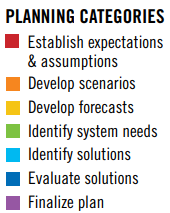
Library users can search for resources relevant to color-coded steps in the comprehensive electricity planning process roadmaps (described in the rainbow image below) or specific scopes of planning (i.e., combinations of resource, distribution, and transmission planning).
This resource library was made possible through support from the U.S. Department of Energy.
The Comprehensive Electricity Planning Resource Library was last updated on 09/04/2026.
Search Filters
93 resources found:
This report explains the value of incorporating distribution planning into integrated resource planning, including opportunities to reduce costs through resource co-optimization and strategic siting of grid-edge resources, and identifies practical ways to better integrate bulk power and distribution planning.
Forthcoming
- Orange - Develop Scenarios
- Green - Identify System Needs
- Blue - Identify Solutions
- DERs, DR, DF, EE, VPPs
- Resilience & Extreme Weather
- Case Study
- Modeling Guide
- Presentation
- Report
This technical brief summarizes policy and regulatory research on the affordability, reliability, and economic development benefits of grid-enhancing technologies (GETs). It also outlines a roadmap of actions that states can take to address barriers to large-scale GET deployment.
- Green - Identify System Needs
- Advanced Transmission Technologies (ATTs)
- Report
This paper presents a framework for state policymakers, public utility commissions, and energy offices to evaluate distributed energy resources using three progressively more complex levels of analysis. The framework is intended to improve DER planning, optimize resource portfolios, support grid modernization, and advance environmental goals.
- Red - Establish Expectations & Assumptions
- Orange - Develop Scenarios
- Green - Identify System Needs
- Blue - Identify Solutions
- Indigo - Evaluate Solutions
- DERs, DR, DF, EE, VPPs
- State Policy Goals
- Report
This presentation introduces an objectives-based decision framework for integrated distribution system planning. It walks through a stakeholder-informed process for grid investment decisions and explains best practices, analytical tools, and stakeholder roles for each step.
- Red - Establish Expectations & Assumptions
- Orange - Develop Scenarios
- Yellow - Develop Forecasts
- Green - Identify System Needs
- Blue - Identify Solutions
- Indigo - Evaluate Solutions
- Purple - Finalize Plan
- Stakeholder Engagement
- State Policy Goals
- Presentation
- Questions to ask utilities
This presentation introduces an integrated distribution planning framework for the Maryland Public Service Commission. It discusses state planning requirements, distributed energy resources as non-wires alternatives, stakeholder engagement, and examples of state planning practices.
- Red - Establish Expectations & Assumptions
- Orange - Develop Scenarios
- Yellow - Develop Forecasts
- Green - Identify System Needs
- Blue - Identify Solutions
- Indigo - Evaluate Solutions
- DERs, DR, DF, EE, VPPs
- Stakeholder Engagement
- Case Study
- Presentation
- Questions to ask utilities
Advanced Transmission Technologies (ATTs) can increase transmission capacity, improve grid flexibility, and reduce costs by making better use of existing infrastructure. This guide provides best practices for integrating ATTs into transmission planning, interconnection studies, and integrated resource planning. Effective deployment requires system-specific analysis, coordination between planning and operations, and improved modeling to ensure ATTs complement conventional transmission investments and long-term grid needs.
Anilkumar, R., Al DahDouh, K., & Nour, W. (2026, March). Advanced Transmission Technologies Planning Guide. Quanta Technology & RMI. https://www.danovoenergy.com/featured-downloads/advanced-transmission-technologies/?media_url=www.danovoenergy.com/wp-content/uploads/2026/03/DES-BR-144-X-03-26_Advanced_Transmission_Technologies.pdf.
- Orange - Develop Scenarios
- Green - Identify System Needs
- Blue - Identify Solutions
- Indigo - Evaluate Solutions
- Advanced Transmission Technologies (ATTs)
- Report
This paper examines how different utility regulatory models influence distribution planning, investment, reliability, and demand response. It presents an integrated modeling framework that evaluates interactions between regulators and utilities and compares planning outcomes across regulatory approaches.
- Indigo - Evaluate Solutions
- DERs, DR, DF, EE, VPPs
- Report
This presentation provides an accessible introduction to electric transmission infrastructure, explaining how transmission systems move high-voltage electricity, the components and construction of transmission lines, and key siting, permitting, safety, and right-of-way considerations.It also highlights how transmission corridors can provide benefits beyond electricity delivery, including habitat conservation, wildfire mitigation, recreation, transportation, and local wealth-building opportunities.
- Blue - Identify Solutions
- Presentation
This white paper reviews the interactions between transmission and distribution systems in increasingly complex power systems. It summarizes current capabilities, development status, and application cases of co-simulation platforms.
- Green - Identify System Needs
- Blue - Identify Solutions
- DERs, DR, DF, EE, VPPs
- Resilience & Extreme Weather
- Risk Analysis
- Report
The report summarizes the Michigan Power Grid initiative's efforts to improve how benefit-cost analysis (BCA) is used in electric distribution planning as the state transitions toward cleaner, distributed energy resources. It explores BCA practices in other states, a consistent frameworks for evaluating utility investments, and applications to distribution planning. The report is intended to help the Michigan Public Service Commission consider updated BCA methodologies when evaluating utility distribution plans.
- Red - Establish Expectations & Assumptions
- Indigo - Evaluate Solutions
- Benefit-Cost Analysis
- DERs, DR, DF, EE, VPPs
- Resilience & Extreme Weather
- State Policy Goals
- Case Study
- Report
This presentation discusses benefit-cost analysis for grid modernization investments in the context of New Mexico's grid modernization statute. It reviews different benefit-cost analysis approaches and highlights best practices for evaluating grid modernization investments.
- Blue - Identify Solutions
- Indigo - Evaluate Solutions
- Benefit-Cost Analysis
- Case Study
- Presentation
This report reviews how electric utilities evaluate the costs and benefits of grid modernization investments in utility planning. It summarizes recent utility practices, discusses benefit-cost analysis methodologies and challenges, and identifies options for state public utility commissions.
- Orange - Develop Scenarios
- Blue - Identify Solutions
- Indigo - Evaluate Solutions
- Benefit-Cost Analysis
- Report
This report updates Synapse's 2013 best practices for integrated resource planning and presents 50 recommendations spanning stakeholder engagement, resource adequacy, model inputs, scenarios, modeling, results evaluation, and coordination with other planning processes. It emphasizes forward-looking planning to meet customer needs and broader utility commitments.
- Red - Establish Expectations & Assumptions
- Orange - Develop Scenarios
- Yellow - Develop Forecasts
- Green - Identify System Needs
- Blue - Identify Solutions
- Indigo - Evaluate Solutions
- Risk Analysis
- Stakeholder Engagement
- Modeling Guide
- Report
The BCA Resource Portfolio compiles U.S. Department of Energy resources designed to help local governments advance energy and sustainability initiatives. It organizes programs, guidance, financing resources, and tools across areas including energy planning, buildings, workforce, utilities, infrastructure, solar, and transportation.
- Red - Establish Expectations & Assumptions
- Building & Vehicle Electrification
- State Policy Goals
- Report
This report examines the data and analyses utilities use to develop distribution system plans and highlights differences in state reporting requirements. It aims to improve transparency by helping regulators and stakeholders better understand the information utilities use to support planning and investment decisions.
- Orange - Develop Scenarios
- Yellow - Develop Forecasts
- Green - Identify System Needs
- Blue - Identify Solutions
- Indigo - Evaluate Solutions
- Purple - Finalize Plan
- DERs, DR, DF, EE, VPPs
- Stakeholder Engagement
- Questions to ask utilities
- Report
This webinar features presentations onIRP best practices, advanced energy modeling, planning for emerging technologies, and regional reliability considerations. It also discusses the importance of accounting for neighboring grids, transmission constraints, uncertainty, and weather conditions in long-term planning.
- Orange - Develop Scenarios
- Yellow - Develop Forecasts
- Green - Identify System Needs
- Blue - Identify Solutions
- Indigo - Evaluate Solutions
- Case Study
- Modeling Guide
- Recording/Video
This report examines how transportation electrification affects integrated distribution planning and identifies challenges associated with electric vehicle adoption. It describes the roles of utility planning, customer collaboration, and stakeholder engagement, and presents four priority actions to support vehicle electrification.
- Orange - Develop Scenarios
- Yellow - Develop Forecasts
- Blue - Identify Solutions
- Benefit-Cost Analysis
- Building & Vehicle Electrification
- Stakeholder Engagement
- State Policy Goals
- Report
This report identifies current and emerging best practices for reducing wildfire risks associated with electric utility infrastructure while maintaining reliability and controlling costs for customers. It organizes utility wildfire resilience into three phases: pre-event prevention, peri-event response, and post-event recovery. The report emphasizes that utilities should tailor these practices to their individual risk profiles and systems while considering regulatory frameworks, costs, shared landscape management, and emerging technologies to reduce ignitions, withstand wildfire impacts, and restore service quickly.
- Blue - Identify Solutions
- Indigo - Evaluate Solutions
- Resilience & Extreme Weather
- Risk Analysis
- Case Study
- Report
This paper examines the technical, regulatory, and policy challenges associated with operating power systems with high penetrations of distributed energy resources. It discusses opportunities for more active distribution system operation as an alternative to capital investment and identifies policy priorities to support increasingly distributed electricity systems.
- Red - Establish Expectations & Assumptions
- Indigo - Evaluate Solutions
- Building & Vehicle Electrification
- DERs, DR, DF, EE, VPPs
- Risk Analysis
- Report
This poster explores how nature-based solutions (NbS) can reduce risks to energy infrastructure from hazards while providing environmental co-benefits. It proposes an analytical framework integrating ecological modeling, energy-system modeling, and risk analysis, with an illustrative flood scenario showing that watershed buffers can preserve transmission capacity and reduce system-wide loss of load.
- Red - Establish Expectations & Assumptions
- Blue - Identify Solutions
- Risk Analysis
- Case Study
- Report
This EPRI white paper identifies emerging resource planning challenges associated with increasing deployment of variable energy resources, distributed energy resources, and expanded customer choice. It highlights the need for improved modeling, integrated forecasting, and broader planning boundaries to address future power system needs.
- Red - Establish Expectations & Assumptions
- Orange - Develop Scenarios
- Yellow - Develop Forecasts
- Blue - Identify Solutions
- DERs, DR, DF, EE, VPPs
- Stakeholder Engagement
- State Policy Goals
- Report
The presentation explains how states and utilities can forecast distributed energy resources (DERs), focusing on energy efficiency, demand flexibility, distributed solar, and battery storage.It highlights different modeling approaches, including treating efficiency and demand flexibility as load reductions or selectable resources, while emphasizing consistent assumptions between DER potential studies and load forecasts.
- Red - Establish Expectations & Assumptions
- Yellow - Develop Forecasts
- DERs, DR, DF, EE, VPPs
- Case Study
- Presentation
- Questions to ask utilities
This IEEE article describes Dominion Energy Virginia's integrated distribution planning road map for managing DER growth and increasing load from electric vehicles and data centers. It outlines planning capabilities across forecasting, system modeling, capacity analysis, DER integration, resilience, data management, and coordinated resource, transmission, and distribution planning.
- Red - Establish Expectations & Assumptions
- Orange - Develop Scenarios
- Yellow - Develop Forecasts
- Green - Identify System Needs
- Blue - Identify Solutions
- Indigo - Evaluate Solutions
- Building & Vehicle Electrification
- DERs, DR, DF, EE, VPPs
- Large Loads
- Case Study
- Report
This white paper reviews current distribution capacity planning practices and identifies challenges related to distributed energy resources, forecasting, uncertainty, and cost allocation. It recommends more granular forecasting, improved data integration, scenario and probabilistic analysis, and broader planning objectives to support future distribution planning.
- Red - Establish Expectations & Assumptions
- Orange - Develop Scenarios
- Yellow - Develop Forecasts
- Green - Identify System Needs
- Blue - Identify Solutions
- Indigo - Evaluate Solutions
- DERs, DR, DF, EE, VPPs
- Risk Analysis
- Report
This study examines how community solar projects affect distribution system upgrade costs and interconnection requirements. Using Berkeley Lab's Least-cost Optimal Distribution Grid Expansion model, it evaluates least-cost infrastructure solutions and identifies policy and deployment strategies for reducing community solar interconnection costs.
- Red - Establish Expectations & Assumptions
- Orange - Develop Scenarios
- Yellow - Develop Forecasts
- Green - Identify System Needs
- Blue - Identify Solutions
- Indigo - Evaluate Solutions
- State Policy Goals
- Report
This report presents a techno-econometric framework for assessing the operational potential of Grid Edge Resources (GERs), including flexible loads, distributed generation, and distributed storage. It describes a probabilistic methodology for accrediting GER portfolios and integrating them into distribution planning to improve affordability and reliability.
- Blue - Identify Solutions
- Indigo - Evaluate Solutions
- DERs, DR, DF, EE, VPPs
- Case Study
- Report
This presentation examines how distributed energy resources, including solar, storage, electric vehicles, demand response, and microgrids, can support distribution system planning. It discusses approaches for valuing DERs, improving hosting capacity analysis, evaluating proactive planning, and developing regulatory frameworks for growing load and DER adoption.
- Blue - Identify Solutions
- Indigo - Evaluate Solutions
- Benefit-Cost Analysis
- Building & Vehicle Electrification
- DERs, DR, DF, EE, VPPs
- Presentation
- Questions to ask utilities
This paper presents a three-stage framework describing how distribution systems evolve as distributed energy resource adoption increases. It outlines the characteristics of Grid Modernization, Operational Markets, and Virtual Power Plants, and discusses the investments, operational changes, and regulatory developments associated with each stage.
- Red - Establish Expectations & Assumptions
- Orange - Develop Scenarios
- Yellow - Develop Forecasts
- Green - Identify System Needs
- Blue - Identify Solutions
- DERs, DR, DF, EE, VPPs
- Report
This report includes a template and companion guide for structuring distribution system plans. For each section in the template, the companion guide includes a description of topics covered and their importance, an example utility approach, and references to other utility plans to serve as models.
- Purple - Finalize Plan
- Benefit-Cost Analysis
- Resilience & Extreme Weather
- Risk Analysis
- Case Study
- Report
This report summarizes distribution system planning approaches that states have adopted to support grid modernization and higher levels of distributed energy resources. It highlights planning elements that other states may adapt to meet their own objectives.
- Red - Establish Expectations & Assumptions
- Blue - Identify Solutions
- Indigo - Evaluate Solutions
- DERs, DR, DF, EE, VPPs
- State Policy Goals
- Case Study
- Report
This paper explains how scenario planning can help address uncertainty in long-term distribution system planning. It defines scenario planning, discusses key considerations for applying it within distribution planning, and illustrates the approach through a case study.
- Orange - Develop Scenarios
- Risk Analysis
- Case Study
- Report
Informational webinars for U.S. DOE Energy Innovator Fellows at utilities, state agencies, and Tribes. Topics include electricity regulation, grid resilience planning, integrated resource planning, DER interconnection, distribution planning for load growth, data centers, and related subjects.
- Red - Establish Expectations & Assumptions
- Orange - Develop Scenarios
- Yellow - Develop Forecasts
- Green - Identify System Needs
- Blue - Identify Solutions
- Indigo - Evaluate Solutions
- Purple - Finalize Plan
- Large Loads
- Resilience & Extreme Weather
- Risk Analysis
- Stakeholder Engagement
- Presentation
- Questions to ask utilities
- Recording/Video
- Webpage
This report evaluates how the Duke Energy's Integrated System and Operations Planning framework interacts with other electricity planning processes in South Carolina. The case study could be useful to audiences in other states who are interested in integrated planning.
- Red - Establish Expectations & Assumptions
- Orange - Develop Scenarios
- Yellow - Develop Forecasts
- Green - Identify System Needs
- Blue - Identify Solutions
- Indigo - Evaluate Solutions
- Benefit-Cost Analysis
- Risk Analysis
- Case Study
- Report
This report describes a structured process for identifying objectives, screening distribution solutions for cost-effectiveness, and prioritizing grid investments using multi-objective decision-making. It also provides examples of emerging best practices and includes a checklist for evaluating cost-effectiveness processes.
- Red - Establish Expectations & Assumptions
- Orange - Develop Scenarios
- Yellow - Develop Forecasts
- Green - Identify System Needs
- Blue - Identify Solutions
- Indigo - Evaluate Solutions
- Benefit-Cost Analysis
- Risk Analysis
- State Policy Goals
- Report
This report supports utilities and regulators in incorporating climate resilience into utility planning. It reviews best practices for forecasting with climate change and discusses resource, asset, and contingency planning, along with data development, regulatory considerations, and emerging planning approaches.
- Red - Establish Expectations & Assumptions
- Orange - Develop Scenarios
- Indigo - Evaluate Solutions
- Resilience & Extreme Weather
- Report
This paper examines how integrated resource planning is evolving to support cleaner energy systems, focusing on modeling tools, capacity value assumptions, and the integration of equity and justice considerations. Based on recent utility IRP proceedings, it concludes that effective planning requires strong regulatory oversight, robust stakeholder engagement, advanced modeling, and adaptable planning processes.
- Blue - Identify Solutions
- Indigo - Evaluate Solutions
- Risk Analysis
- Stakeholder Engagement
- State Policy Goals
- Case Study
- Report
This report explains how flexible connections and dynamic operating envelopes can support the integration of distributed energy resources and electric vehicle charging while reducing infrastructure costs. It reviews both customer-controlled and utility-controlled approaches for managing distribution system capacity constraints.
- Red - Establish Expectations & Assumptions
- Blue - Identify Solutions
- Building & Vehicle Electrification
- DERs, DR, DF, EE, VPPs
- Report
This report examines why demand response participation in wholesale electricity markets has remained limited despite its potential to improve reliability and reduce price volatility. It identifies barriers to participation and proposes actions to expand the use of demand response as the electricity system evolves.
- Blue - Identify Solutions
- DERs, DR, DF, EE, VPPs
- Report
This analysis evaluates the potential for grid-enhancing technologies (GETs) to accelerate the interconnection of new generation across five states in PJM. It finds that GETs could enable 6.6 GW of solar, wind, and storage projects to interconnect by 2027 while reducing network upgrade costs by $272–$523 million. GETs and the generation they enable could also reduce energy production costs by roughly $1 billion annually, demonstrating their potential as a faster, lower-cost complement to traditional transmission upgrades.
Katie Siegner, Sarah Toth, Chaz Teplin, and Katie Mulvaney, GETting Interconnected in PJM: Grid-Enhancing Technologies (GETs) Can Increase the Speed and Scale of New Entry from PJM’s Queue, RMI, 2024, https:// rmi.org/insight/analyzing-gets-as-a-tool-for-increasing-interconnection-throughput-from-pjmsqueue/.
- Red - Establish Expectations & Assumptions
- Blue - Identify Solutions
- Indigo - Evaluate Solutions
- Purple - Finalize Plan
- Advanced Transmission Technologies (ATTs)
- Case Study
- Report
The presentation examines how distributed energy resources (DERs) can be aggregated and integrated into wholesale electricity markets, with particular focus on FERC Orders 2222 and 719 and the role of state regulators. It highlights the regulatory, operational, and technical changes needed—including stronger coordination among utilities, aggregators, and grid operators—to capture DER value while maintaining reliability.
- Red - Establish Expectations & Assumptions
- Yellow - Develop Forecasts
- DERs, DR, DF, EE, VPPs
- Presentation
This report outlines planning approaches that can help utilities prepare for increased building electrification. It recommends improving forecasting, modernizing planning methods, using energy efficiency and demand management to reduce grid impacts, and coordinating electric and natural gas planning to support more cost-effective infrastructure investments.
- Orange - Develop Scenarios
- Yellow - Develop Forecasts
- Benefit-Cost Analysis
- Building & Vehicle Electrification
- State Policy Goals
- Report
This report provides a template that states and utilities can use to prepare grid resilience plans, either as part of a distribution system plan or as a standalone filing. It includes guidance on vulnerability assessments, resilience programs, projected costs, and rate impacts while addressing threats such as extreme weather, cyberattacks, physical attacks, and seismic events.
- Red - Establish Expectations & Assumptions
- Benefit-Cost Analysis
- Resilience & Extreme Weather
- Risk Analysis
- Questions to ask utilities
- Report
This resource identifies opportunities for communities to participate in distribution system planning to advance goals such as affordability. It discusses engagement in topics including non-wires alternatives, DER forecasting, and scenario analysis, and provides examples and procedural guidance for participation.
- Red - Establish Expectations & Assumptions
- Orange - Develop Scenarios
- Yellow - Develop Forecasts
- Green - Identify System Needs
- Blue - Identify Solutions
- Indigo - Evaluate Solutions
- Purple - Finalize Plan
- DERs, DR, DF, EE, VPPs
- Stakeholder Engagement
- Case Study
- Questions to ask utilities
- Report
This website provides additional resources and reference materials related to integrated distribution system planning.
- Red - Establish Expectations & Assumptions
- Orange - Develop Scenarios
- Yellow - Develop Forecasts
- Green - Identify System Needs
- Blue - Identify Solutions
- Indigo - Evaluate Solutions
- Building & Vehicle Electrification
- DERs, DR, DF, EE, VPPs
- Webpage
This report provides an overview of integrated distribution planning and explains why states and utilities are moving toward this approach as DER adoption and clean energy goals expand. It introduces a four-phase transition framework and discusses key planning challenges and considerations.
- Red - Establish Expectations & Assumptions
- Yellow - Develop Forecasts
- Blue - Identify Solutions
- DERs, DR, DF, EE, VPPs
- Stakeholder Engagement
- Report
This report describes key capabilities needed for integrated distribution planning, including advanced forecasting, hosting capacity analysis, disclosure of grid needs, new approaches to acquiring non-wires alternatives, and meaningful stakeholder engagement. It also provides recommendations for commissions on establishing objectives, assessing current utility planning practices, and creating technical working groups to support implementation.
- Yellow - Develop Forecasts
- Green - Identify System Needs
- Blue - Identify Solutions
- Indigo - Evaluate Solutions
- Resilience & Extreme Weather
- Risk Analysis
- Stakeholder Engagement
- Modeling Guide
- Report
This presentation focuses on current integrated distribution system planning practices, including goals and objectives, integration with other planning processes, and scenario analysis. It also provides an overview of Berkeley Lab's recently launched distribution planning tools and resources.
- Red - Establish Expectations & Assumptions
- Orange - Develop Scenarios
- Yellow - Develop Forecasts
- Green - Identify System Needs
- Blue - Identify Solutions
- Indigo - Evaluate Solutions
- Purple - Finalize Plan
- State Policy Goals
- Presentation
- Questions to ask utilities
This resource provides a series of video training sessions on electricity modeling. Topics include integrating distributed energy resources into bulk power system models, planning for climate variability, and related modeling subjects.
- Red - Establish Expectations & Assumptions
- Orange - Develop Scenarios
- Yellow - Develop Forecasts
- Green - Identify System Needs
- Blue - Identify Solutions
- Indigo - Evaluate Solutions
- DERs, DR, DF, EE, VPPs
- Resilience & Extreme Weather
- Risk Analysis
- Recording/Video
- Webpage
The set of three reports provide a practical framework for integrating electricity planning across generation, transmission, distribution, and customer resources. Together, they define integrated planning, recommend practical coordination strategies, and explore opportunities to incorporate integrated planning into capacity expansion models.
- Red - Establish Expectations & Assumptions
- Orange - Develop Scenarios
- Yellow - Develop Forecasts
- Green - Identify System Needs
- Blue - Identify Solutions
- Indigo - Evaluate Solutions
- Large Loads
- Stakeholder Engagement
- State Policy Goals
- Modeling Guide
- Report
This resource provides a framework for integrated resilient distribution planning that supports the coordination of resilience and distribution planning activities.
- Red - Establish Expectations & Assumptions
- Orange - Develop Scenarios
- Yellow - Develop Forecasts
- Green - Identify System Needs
- Blue - Identify Solutions
- Indigo - Evaluate Solutions
- Resilience & Extreme Weather
- Risk Analysis
- Stakeholder Engagement
- State Policy Goals
- Report
This paper advocates for transitioning from siloed utility planning processes to Integrated System Planning (ISP) to support reliable, affordable, and sustainable electricity systems. It describes the core elements of ISP, highlights examples from utilities including Xcel Energy, Hawaiian Electric, and Salt River Project, and outlines a planning process that coordinates investments across generation, transmission, distribution, and customer resources.
- Red - Establish Expectations & Assumptions
- Orange - Develop Scenarios
- Yellow - Develop Forecasts
- Green - Identify System Needs
- Blue - Identify Solutions
- Indigo - Evaluate Solutions
- DERs, DR, DF, EE, VPPs
- Resilience & Extreme Weather
- Risk Analysis
- Stakeholder Engagement
- Case Study
- Modeling Guide
- Report
This paper examines the need for transmission and distribution co-simulation platforms to evaluate how distributed energy resources (DERs) can provide bulk power system services under FERC Order 2222. It presents a new co-simulation platform and demonstrates, through a Western Interconnection case study, that DERs can reliably provide ancillary services while supporting coordinated transmission and distribution analysis.
- Blue - Identify Solutions
- Indigo - Evaluate Solutions
- DERs, DR, DF, EE, VPPs
- Case Study
- Report
This report presents a framework for states and utilities that want to advance integration of resilience and distribution planning. It explains how coordinated planning can optimize investments, avoid redundant infrastructure, support growing customer demand, and maintain long-term system performance.
- Red - Establish Expectations & Assumptions
- Blue - Identify Solutions
- Indigo - Evaluate Solutions
- Resilience & Extreme Weather
- Risk Analysis
- Case Study
- Report
The Interconnection Innovation e-Xchange initiative focuses on enabling simple, fast and affordable interconnection while enhancing the reliability and security of the grid. The webpage has strategic roadmaps, stakeholder engagement, data & analytics, and research & innovation to advance open dialogue on interconnection challenges, knowledge gaps, and solutions. It
- Blue - Identify Solutions
- Indigo - Evaluate Solutions
- DERs, DR, DF, EE, VPPs
- Webpage
The presentation provides state utility regulators with guidance and resources for modernizing DER interconnection rules as distributed solar, storage, and other resources become more prevalent. It emphasizes aligning interconnection requirements with broader grid planning and policy, adopting current standards, and coordinating among regulators, utilities, reliability coordinators, and other stakeholders.
- Red - Establish Expectations & Assumptions
- DERs, DR, DF, EE, VPPs
- Stakeholder Engagement
- State Policy Goals
- Presentation
This brief examines mobile energy storage systems (Mobile-ESS) as flexible power sources for emergency response, disaster recovery, and off-grid applications. It highlights their potential to improve energy resilience while identifying key barriers, including cost, capacity, safety, and regulatory challenges.
- Purple - Finalize Plan
- Building & Vehicle Electrification
- Resilience & Extreme Weather
- Case Study
- Report
This paper examines how increasing distributed generation affects transmission expansion planning in the Western Interconnection. It finds that transmission investment needs depend on the location, timing, and scale of distributed generation, emphasizing the importance of coordinated planning and accurate forecasting.
- Yellow - Develop Forecasts
- Green - Identify System Needs
- Blue - Identify Solutions
- Indigo - Evaluate Solutions
- State Policy Goals
- Case Study
- Report
This report introduces a maturity model that regulators and utilities can use to evaluate and expand demand flexibility programs. It defines six capability categories and describes maturity levels ranging from below expectations to improving on best practices.
- Blue - Identify Solutions
- Indigo - Evaluate Solutions
- Benefit-Cost Analysis
- DERs, DR, DF, EE, VPPs
- Report
This report explores how transmission rights-of-way can be designed as multifunctional corridors that maintain grid reliability while also providing recreational, ecological, and local economic benefits.
- Indigo - Evaluate Solutions
- Case Study
- Report
This paper summarizes findings from 2024 NARUC roundtable meetings on integrated resource planning and reviews regulatory approaches that states are using or considering to address emerging planning challenges such as resource adequacy, changing resource mixes, state policy requirements, and load growth.
- Red - Establish Expectations & Assumptions
- Blue - Identify Solutions
- Indigo - Evaluate Solutions
- Large Loads
- State Policy Goals
- Case Study
- Report
The report describes how Maryland applied the National Standard Practice Manual (NSPM) to improve benefit-cost analysis for distributed energy resources, first for electric vehicles and then for energy efficiency. Building on these efforts, the Maryland Public Service Commission launched a process to develop a Unified BCA framework across DERs to improve consistency and help identify least-cost approaches for achieving state climate and equity goals.
- Red - Establish Expectations & Assumptions
- Indigo - Evaluate Solutions
- Benefit-Cost Analysis
- Building & Vehicle Electrification
- DERs, DR, DF, EE, VPPs
- State Policy Goals
- Case Study
- Report
The report explains how Michigan applied the National Standard Practice Manual to develop a consistent benefit-cost analysis framework for evaluating distributed energy resources. The resulting Michigan Societal Test considers utility, customer, and broader societal impacts to align DER investments with state policy goals.
- Red - Establish Expectations & Assumptions
- Indigo - Evaluate Solutions
- Benefit-Cost Analysis
- DERs, DR, DF, EE, VPPs
- Stakeholder Engagement
- State Policy Goals
- Case Study
- Report
The National Standard Practice Manual for Benefit-Cost Analysis of Distributed Energy Resources provides a comprehensive framework for cost-effectiveness assessment of DERs. The manual offers a set of policy-neutral, non-biased, and economically-sound principles, concepts, and methodologies to support single- and multi-DER benefit-cost analysis. It is intended for use by jurisdictions to help inform which resources to acquire to meet their specific policy goals and objectives.
- Red - Establish Expectations & Assumptions
- Indigo - Evaluate Solutions
- Benefit-Cost Analysis
- Building & Vehicle Electrification
- DERs, DR, DF, EE, VPPs
- State Policy Goals
- Case Study
- Report
This report explores the current state of electric and natural gas planning and examines the benefits and challenges of integrating these processes. It describes the characteristics of integrated electric and gas distribution planning and identifies indicators of progress toward greater coordination.
- Red - Establish Expectations & Assumptions
- Yellow - Develop Forecasts
- Indigo - Evaluate Solutions
- Purple - Finalize Plan
- DERs, DR, DF, EE, VPPs
- Gas-Electric Planning
- Questions to ask utilities
- Report
This presentation introduces integrated distribution planning concepts and reviews state approaches for using distribution planning to support distributed energy resources and grid modernization. It distinguishes distribution planning from integrated resource and transmission planning, highlights state examples and non-wires alternatives, and identifies practical starting points for regulators.
- Red - Establish Expectations & Assumptions
- Orange - Develop Scenarios
- Green - Identify System Needs
- Blue - Identify Solutions
- Indigo - Evaluate Solutions
- DERs, DR, DF, EE, VPPs
- Risk Analysis
- Stakeholder Engagement
- State Policy Goals
- Case Study
- Presentation
- Questions to ask utilities
This paper assess the advnatges of leveraging the full capabilities of exisitng inverter-based resources using a simulation exercise. It compares plant-level and inverter-level controls for frequency response and voltage control, demonstrating the value of performance-based specifications for advanced grid services.
- Orange - Develop Scenarios
- Indigo - Evaluate Solutions
- Modeling Guide
- Report
Interregional transmission projects face major technical, regulatory, institutional, and financial barriers, including fragmented planning processes, inconsistent modeling and data practices, multiple jurisdictions, and unclear responsibility for interregional planning. This supplemental report examines those barriers and identifies potential strategies that federal and state governments, RTOs/ISOs, utilities, and other industry participants could pursue to improve interregional planning and development, emphasizing its potential role in reducing consumer costs, limiting outages, and modernizing the U.S. electric grid.
- Red - Establish Expectations & Assumptions
- Green - Identify System Needs
- Blue - Identify Solutions
- Indigo - Evaluate Solutions
- Benefit-Cost Analysis
- State Policy Goals
- Report
This report introduces what proactive investments are, what these investments aim to address and the risks they present, and how to processes can be developed and implemented to support proactice investments. It discusses methods for identifying investment opportunities, assessing prudency, and designing fair approaches for cost allocation and recovery.
- Indigo - Evaluate Solutions
- Risk Analysis
- Report
This PNNL and RMI workshop pre-read examines how utility regulation can evolve to support proactive grid investments needed for accelerating electrification and rapidly growing electricity demand while protecting customers from unnecessary costs and risks. It argues that traditional, reactive approaches to grid planning may cause interconnection delays, reliability challenges, and inefficient infrastructure investment as demand from transportation, buildings, manufacturing, data centers, and other large loads increases. Drawing on state regulatory proceeding examples , it explores emerging approaches such as longer planning horizons, scenario-based and granular forecasting, proactive investment frameworks, alternative cost-recovery mechanisms, and stronger customer safeguards.
- Yellow - Develop Forecasts
- Building & Vehicle Electrification
- Large Loads
- State Policy Goals
- Case Study
- Report
This report summarizes a July 2024 workshop led by Pacific Northwest National Laboratory and RMI focused on how utilities and regulators can proactively prepare the electric grid for rapid electrification and growing electricity demand while minimizing customer costs and risks. Participants identified limitations in traditional utility planning and regulatory practices, which may not support timely investment amid uncertainty about the scale, location, and timing of future demand. The report documents key regulatory challenges, uncertainties, information gaps, and potential near- and long-term solutions for utilities, regulators, policymakers, researchers, and DOE to explore further.
- Red - Establish Expectations & Assumptions
- Orange - Develop Scenarios
- Yellow - Develop Forecasts
- Building & Vehicle Electrification
- DERs, DR, DF, EE, VPPs
- Gas-Electric Planning
- Large Loads
- State Policy Goals
- Report
This report provides an overview of integrated resource planning statutes and regulations from Midwestern and other states with IRP requirements. It is based on research and discussions with current and former regulatory commission staff and is intended to help stakeholders understand IRP requirements.
- Red - Establish Expectations & Assumptions
- Orange - Develop Scenarios
- Yellow - Develop Forecasts
- Indigo - Evaluate Solutions
- Purple - Finalize Plan
- Stakeholder Engagement
- Case Study
- Report
This presentation reviews grid modernization cost-recovery proceedings across multiple states and examines factors that influence regulatory decisions. It finds that regulators favor investments supported by clear policy objectives, strong benefit-cost analysis, and consideration of alternatives, while highlighting common reasons for regulatory concerns.
- Red - Establish Expectations & Assumptions
- Blue - Identify Solutions
- Indigo - Evaluate Solutions
- Benefit-Cost Analysis
- Risk Analysis
- State Policy Goals
- Case Study
- Presentation
This report identifies three qualities that effective integrated resource plans should maintain: trust, comprehensiveness, and alignment. It also highlights examples of leading IRP practices that help utilities and regulators evaluate resource decisions under changing conditions.
- Red - Establish Expectations & Assumptions
- Green - Identify System Needs
- Blue - Identify Solutions
- Indigo - Evaluate Solutions
- Stakeholder Engagement
- Case Study
- Report
This literature review examines integrated gas and electric system planning and summarizes examples from states and utilities. It highlights approaches to coordinating planning across electric and natural gas systems.
- Red - Establish Expectations & Assumptions
- Gas-Electric Planning
- Case Study
- Report
This paper examines how utilities can evolve sourcing methods for distributed energy resources to better meet local distribution system needs. It proposes aligning tariffs, demand-side management programs, and procurements while strengthening value propositions for customers and aggregators.
- Green - Identify System Needs
- Blue - Identify Solutions
- Indigo - Evaluate Solutions
- Benefit-Cost Analysis
- DERs, DR, DF, EE, VPPs
- Report
This paper describes distribution services contracts between electric utilities and distributed energy resource aggregators. It reviews key contractual elements, summarizes the broader DER aggregation lifecycle, and provides suggested actions for regulators, utilities, aggregators, and standards organizations.
- Green - Identify System Needs
- Blue - Identify Solutions
- Indigo - Evaluate Solutions
- Purple - Finalize Plan
- DERs, DR, DF, EE, VPPs
- Report
This paper describes how State Energy Offices can contribute to distribution system planning through planning activities, studies, stakeholder engagement, program implementation, and regulatory proceedings. It provides examples of state practices that support grid modernization, DER integration, reliability, resilience, and long-term investment decisions.
- Red - Establish Expectations & Assumptions
- DERs, DR, DF, EE, VPPs
- Resilience & Extreme Weather
- Stakeholder Engagement
- State Policy Goals
- Report
This webpage highlights leading distribution system planning practices across areas such as load and distributed energy resource forecasting, grid modernization, hosting capacity, non-wires alternatives, reliability and resilience, stakeholder engagement, and equity. The interactive resource also links users to relevant state legislation, regulatory proceedings, utility filings, and planning requirements, making it useful for comparing distribution planning approaches across states.
- Red - Establish Expectations & Assumptions
- Orange - Develop Scenarios
- Yellow - Develop Forecasts
- DERs, DR, DF, EE, VPPs
- Large Loads
- Resilience & Extreme Weather
- Stakeholder Engagement
- State Policy Goals
- Case Study
- Report
- Webpage
This report summarizes the Integrated Distribution System Planning framework using examples from 18 states. It reviews leading practices related to planning objectives, stakeholder engagement, forecasting, hosting capacity analysis, and coordination across integrated resource, transmission, and distribution planning.
- Orange - Develop Scenarios
- Yellow - Develop Forecasts
- Blue - Identify Solutions
- Indigo - Evaluate Solutions
- DERs, DR, DF, EE, VPPs
- Resilience & Extreme Weather
- Stakeholder Engagement
- State Policy Goals
- Case Study
- Questions to ask utilities
- Report
This report summarizes the major types of electric distribution system analyses, their applications, and their maturity. It emphasizes analytical capabilities needed to support increasing levels of distributed energy resources and identifies current capabilities and remaining gaps.
- Blue - Identify Solutions
- DERs, DR, DF, EE, VPPs
- Report
This report examines emerging issues that will shape the future of electricity resource planning, including central-scale generation, distributed generation, demand-side resources, transmission, and uncertainty management. Its analysis draws on recent resource plans from 10 utilities representing diverse planning approaches.
- Red - Establish Expectations & Assumptions
- Green - Identify System Needs
- Blue - Identify Solutions
- Indigo - Evaluate Solutions
- Risk Analysis
- Stakeholder Engagement
- Case Study
- Report
This report highlights the role of electric distribution systems in improving resilience and integrating distributed renewable energy resources. It discusses six planning elements, including integrated distribution planning, DERs, electric vehicles, situational awareness, microgrids, and equitable cost recovery.
- Red - Establish Expectations & Assumptions
- Blue - Identify Solutions
- Indigo - Evaluate Solutions
- Building & Vehicle Electrification
- DERs, DR, DF, EE, VPPs
- Resilience & Extreme Weather
- Case Study
- Report
Drawing on work in six U.S. states, this paper examines how integrated resource planning and energy efficiency practices are beginning to converge. It finds that while some effective practices exist for incorporating energy efficiency into resource planning, they are not yet widely adopted.
- Blue - Identify Solutions
- DERs, DR, DF, EE, VPPs
- Case Study
- Report
This brief examines how price-based demand response is considered in integrated resource planning and distribution planning. It finds that the resource is evaluated infrequently and often inadequately, and provides recommendations for improving its treatment in long-term planning.
- Blue - Identify Solutions
- Indigo - Evaluate Solutions
- DERs, DR, DF, EE, VPPs
- Case Study
- Policy Document
This report highlights key considerations for retail regulators in SPP or MISO in states that previously opted out of allowing third-party aggregation participation and may want to reverse that decision due to changing policy enviornments or tightening resource adequacy constraints. It examines the potential benefits and tradeoffs of enabling distributed energy resource aggregations to provide bulk power system services under evolving FERC policies.
- Red - Establish Expectations & Assumptions
- Orange - Develop Scenarios
- Green - Identify System Needs
- DERs, DR, DF, EE, VPPs
- Stakeholder Engagement
- State Policy Goals
- Case Study
- Report
This paper reviews the coordination of transmission and distribution system operators in procuring balancing and congestion management services from distributed energy resources. It examines DER flexibility integration, coordination schemes, transmission-distribution optimization, and data exchange while identifying key technical, economic, and regulatory barriers.
- Red - Establish Expectations & Assumptions
- Blue - Identify Solutions
- DERs, DR, DF, EE, VPPs
- Risk Analysis
- Report
This fact sheet explains how U.S. transmission planning differs between Regional Transmission Organizations/Independent System Operators (RTOs/ISOs) and traditional wholesale electricity markets, including their roles, regulatory structures, and geographic coverage.It also outlines regional planning models—from RTO/ISO-led to utility-led approaches—and highlights how changing generation resources and new FERC requirements are driving the evolution of transmission planning.
- Red - Establish Expectations & Assumptions
- Report
This factsheet explains key transmission planning definitions and acronyms.
- Red - Establish Expectations & Assumptions
- Report
This fact sheet explains the complementary roles of FERC and NERC in U.S. transmission planning: FERC establishes the rules and procedures governing how transmission planning occurs, while NERC develops and enforces reliability standards defining how the transmission system must perform.
- Red - Establish Expectations & Assumptions
- Report
This presentation discusses how energy efficiency can help meet distribution system capacity needs as a non-wires alternative. It reviews state objectives, planning practices, and examples from several states where energy efficiency is being used to defer or avoid traditional distribution investments.
- Blue - Identify Solutions
- DERs, DR, DF, EE, VPPs
- Case Study
- Presentation
Based on interviews with subject matter experts, this report outlines actions utilities and regulators can take to expand virtual power plants. It discusses successful approaches to VPP design, deployment, and operation and is accompanied by a companion report describing VPP profiles and inventories of existing programs.
- Blue - Identify Solutions
- Indigo - Evaluate Solutions
- DERs, DR, DF, EE, VPPs
- Questions to ask utilities
- Report
This resource provides a large collection of practical and educational materials related to federal, regional, and state policy levers for Grid Enhancing Technologies.
- Green - Identify System Needs
- Advanced Transmission Technologies (ATTs)
- Webpage
This PNNL website provides a Wildfire Mitigation Plans Database and analysis hub for examining how electric utilities address wildfire risk.
- Blue - Identify Solutions
- Indigo - Evaluate Solutions
- Advanced Transmission Technologies (ATTs)
- Resilience & Extreme Weather
- Risk Analysis
- State Policy Goals
- Webpage
Displaying 93 resources.
Clear Categories, Topics, Types, & Planning Scope